Your eye care practice might offer exceptional clinical care, but understanding how anchor text for eye care practices connects specialty services to physical locations is critical for local map rankings.
The problem might not be your clinical reputation. It might be how your website communicates your expertise to search engines. One overlooked part of that communication is internal anchor text.
Anchor text is the clickable wording used to link one page to another.
It helps users navigate your website and gives search engines additional context about the destination page.
For independent eye care practices, that context matters.
If you offer Dry Eye IPL, Scleral Lens Fitting and Myopia Management, your website should do more than mention these services. It should establish clear connections between your practice, your doctors, the treatments you offer and the locations you serve.
Let’s look at why.
Why Anchor Text for Eye Care Practices Drives Map Pack Dominance
Your website should not simply contain evidence of your clinical expertise. Its structure should help people and search engines discover how that expertise connects to the services you provide.
Imagine your practice offers myopia management.
You have a dedicated myopia service page. Your lead optometrist has a detailed biography explaining their clinical experience. You also have a page outlining the eye conditions your practice treats.
Individually, these pages contain useful information.
But what happens if the doctor’s biography never links to the myopia management page?
What if your eye conditions page mentions myopia but doesn’t link to the relevant service?
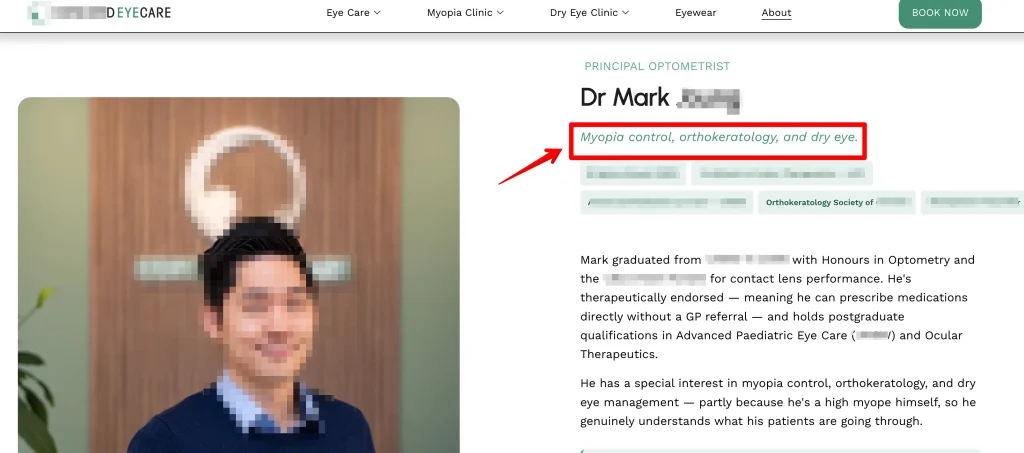
(Screenshot of a doctor’s bio page not linking to the practice’s specialty pages)
What if your service page provides no clear connection to the practitioner delivering that care?
Your website contains the information, but the connections between those pieces are weak.
This is where internal linking becomes important.
Consider the difference between these two links:
- Learn more
- Explore our glaucoma management services
Both can point to the same destination. However, the second gives users and search engines more information about the linked page before they follow it.
That does not mean generic anchor text automatically damages your rankings. It means descriptive anchor text can provide useful context that generic wording does not.
Why Anchor Text Matters in Medical SEO
Good anchor text is not about forcing keywords into every link. It is about describing the destination accurately and making the relationship useful. Similar to what your XML sitemap does, Google uses links to discover pages and understand relationships between content. Descriptive anchor text helps explain what a linked page is about.
For medical and eye care websites, accuracy matters particularly because health information can influence important decisions.
Consider these examples:
| Generic anchor text | More descriptive anchor text |
| Read more | Learn about our Dry Eye IPL treatment |
| Our services | Explore our scleral lens fitting services |
| Meet our team | Meet our glaucoma management specialist |
| Find out more | Discover our myopia management programme |
The descriptive versions communicate a clearer purpose.
However, specificity must not come at the expense of accuracy. If a practitioner does not provide a particular treatment, your links should never imply otherwise.
Google’s quality guidance emphasises factors such as effort, originality, skill and accuracy when assessing the quality of a page. Simply inserting keywords into links does not demonstrate those qualities. Your website must provide useful, accurate information that reflects the actual services and expertise of your practice.
This is also why copying the same generic linking structure across every practice website is rarely a substitute for understanding each practice’s services, practitioners and patients.
Three Ways Internal Anchor Text Can Strengthen Your Website
1. Connect your doctors to your high-value services
Suppose a patient visits your website to learn about your dry eye services. Your doctor’s biography explains their experience treating dry eye conditions, but the page does not link to your dedicated Dry Eye IPL treatment page.
You are missing a useful opportunity to connect the practitioner’s expertise with the service they provide.
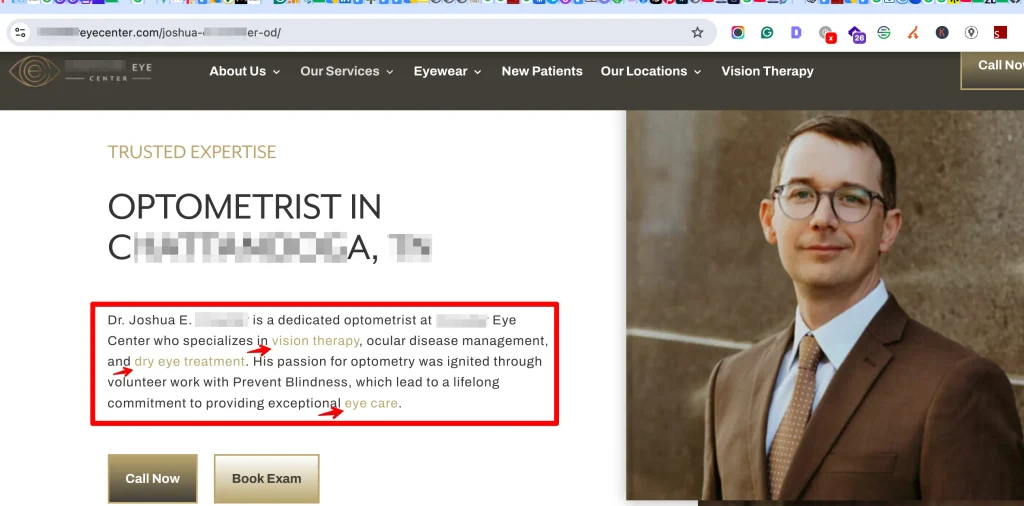
(Screenshot of a doctor’s bio page linking to the clinic’s specialty pages)
A relevant link, such as “Explore our Dry Eye IPL treatment,” can help patients discover the service and provide search engines with additional context. The same principle applies to glaucoma management, scleral lenses, and myopia management.
Where the relationship is accurate, connect your practitioner pages to relevant service pages, and link back where it helps users understand who provides the treatment.
2. Make your local relevance clearer
Location matters when patients search for eye care services.
Someone searching for “myopia management in Cary, North Carolina” wants to find a suitable provider in that area. Your website should make your practice location, relevant services, and practitioner information easy to understand.
For example, a location page could link to a dedicated myopia management page using descriptive wording that reads naturally.
The goal is not to repeat your city name in every link. Excessive exact-match anchor text can look manipulative and make your content less natural. Instead, build meaningful connections between your locations and the services genuinely available there.
This can support your broader local SEO strategy, although internal anchor text alone cannot guarantee a higher Google Map Pack position or an AI search recommendation.
3. Give important service pages a clearer place in your website structure
Many independent eye care websites give their general services page prominent placement while leaving specialised treatments several clicks away, with few relevant internal links pointing towards them.
If Dry Eye IPL or Scleral Lens Fitting is an important service for your practice, make sure visitors can find it easily. Link to the relevant page from appropriate service overviews, practitioner biographies and educational articles.
Use anchor text that describes the destination, and ensure the destination page provides substantive information about the treatment.
This helps users navigate your website and gives search engines additional pathways to discover and understand important pages.
Three Internal Anchor Text Checks for Your Practice
You do not need to overhaul your entire website to begin identifying opportunities.
Start with these three checks:
1. Find generic links pointing to important service pages.
Look for repeated uses of “Learn more”, “Click here” and “Read more”. Replace them where appropriate with descriptive wording that accurately reflects the destination.
2. Review the connections between practitioners and services.
Check whether your doctor’s biography links to the relevant treatments they provide. Review whether your service pages help patients identify the practitioners responsible for delivering that care.
3. Prioritise links to commercially important services.
Identify the specialty services you want more suitable patients to discover. Ensure those pages are accessible through relevant internal links, rather than relying on patients or search engines to find them by chance.
Remember that anchor text is only one part of the picture. Crawlability, useful content, page quality, site architecture, local signals, and accurate structured data all contribute to a stronger search foundation.
There is no special anchor text formula that guarantees rankings. The objective is to make your website more coherent, useful, and understandable.
Turn Your Clinical Authority Into Stronger Search Visibility
Your practice may already have the expertise, reputation, and specialist services patients are looking for. The question is whether your website communicates those strengths clearly.
At LindsayWhispers SEO, we help independent eye care practices identify technical and structural gaps that may be limiting their visibility across Google and AI search.
That includes reviewing how your website connects its practitioners, specialty services, conditions, and locations.
Is your website making those connections clearly?
Book a 20-minute Practice Entity Diagnosis to discuss your practice’s technical search foundations and identify opportunities worth investigating.
👉 https://calendly.com/lindsay-lindsaywhispersseo
Your clinical expertise deserves a website that clearly communicates it.